## Summary

Split from #1547 per review feedback.

When scanning existing download status, `get_downloaded_size()` returns
bytes from either the final file or its `.partial` counterpart — so a
`.partial` file with all bytes downloaded (e.g. process killed before
hash verification and rename) could be falsely reported as complete.

The previous approach (commit 3b54e7df) added a byte-comparison fallback
in the coordinator (`downloaded >= total > 0`), but this suffered from
the same `.partial` conflation issue.

**Fix:** Check whether the final (non-`.partial`) file actually exists
on disk before marking status as `"complete"` in `download_utils.py`.
This is the only reliable signal that hash verification passed and the
rename from `.partial` succeeded. The coordinator-level byte comparison
is removed since the source now reports correctly.

### Changes
- `download_utils.py`: Add `final_file_exists` check — only report
`"complete"` when the renamed, hash-verified file exists with matching
size
- `coordinator.py`: Revert to simple `progress.status == "complete"`
check, removing the byte-comparison fallback

**Note:** The corresponding byte-comparison workaround in #1547 should
also be removed.

## Test plan
- [x] basedpyright — 0 errors
- [x] ruff check — passes
- [x] pytest — 218 passed, 1 skipped (1 pre-existing Rust bindings
failure)

🤖 Generated with [Claude Code](https://claude.com/claude-code)

---------

Co-authored-by: Claude Opus 4.6 <noreply@anthropic.com>
## Motivation

When a model has multiple quantization variants (e.g., 4-bit, 8-bit),
expanding the group shows each variant's quantization and size — but
there's no way to see which specific nodes have each variant downloaded.
The top-level model group has an (i) info button, but the individual
variant rows don't. This makes it hard to tell which nodes have which
quantization.

## Changes

- Added an (i) info button to each expanded variant row in
`ModelPickerGroup.svelte`
- When clicked, opens the existing info modal scoped to that single
variant (showing its quantization, size, and which nodes have it
downloaded)
- Changed the variant row element from `<button>` to `<div
role="button">` to allow nesting the info `<button>` (matching the
pattern used by the top-level model row)

## Why It Works

Reuses the existing `onShowInfo` callback and info modal by constructing
a synthetic single-variant `ModelGroup` from the clicked variant. No
changes needed to `ModelPickerModal.svelte` — the info modal already
handles single-variant groups correctly.

## Test Plan

### Manual Testing
<!-- Hardware: MacBook Pro -->
- Open dashboard, open model picker
- Expand a model with multiple variants — each variant row now has an
(i) icon
- Click a variant's (i) — the info modal shows that single variant's
quantization/size and which nodes have it downloaded

### Automated Testing
- Dashboard builds successfully with `npm run build`
- `nix fmt` passes

Co-authored-by: Claude Opus 4.6 <noreply@anthropic.com>
## Motivation

The current chat experience requires users to manually select a model
before they can start chatting. This creates unnecessary friction —
especially for new users who may not know which model to pick.
Additionally, models that are already running or downloading appear
greyed out in the picker if available memory is low, making them
impossible to select even though they're already loaded.

## Changes

### New: ChatModelSelector component
- Category-based model recommendations (Best for Coding, Writing,
Agentic, Biggest) shown on the idle chat screen
- Tiered model ranking system (`AUTO_TIERS`) that picks the best model
fitting available memory
- Fixed-position tooltips that escape overflow-hidden ancestors

### Auto model selection from chat
- Typing in an empty chat auto-picks the best model using tier rankings
- Prefers already-running models over launching smaller new ones (avoids
the "launched a big model but recommends a smaller one" bug)
- If a model is already downloading/loading, attaches to existing
progress instead of launching a duplicate

### Launch-from-chat state machine
- Full `idle → launching → downloading → loading → ready` flow with
inline progress display
- `pendingAutoMessage` queue: messages typed during model launch are
remembered and sent once model is ready
- Fixed `$effect` race condition where restore effect competed with
auto-advance effect, causing lost messages

### Model picker improvements
- Instance status badges: green dot (ready), blue pulsing (downloading),
yellow pulsing (loading) on both group and variant rows
- "Ready" availability filter in ModelFilterPopover
- **Models with active instances (ready, downloading, loading) are never
greyed out** regardless of memory — they're already loaded/in-progress
and must be selectable

### Home page model display
- Model picker button shows the best running model name instead of "—
SELECT MODEL —" when a model is already active
- Uses the same `bestRunningModelId` tier-based derived as the chat
auto-selection

### Chat sidebar & form
- ChatSidebar conversation management with rename, delete, "New Chat"
- `userForcedIdle` guard prevents reactive effects from overriding
explicit user actions (e.g., clicking "New Chat")
- ChatForm simplified: uses ModelPickerModal instead of inline dropdown,
`modelDisplayOverride` prop for showing auto-selected models

## Why It Works

The tier-based auto-selection (`getAutoTierIndex` + `pickAutoModel`)
ensures users always get the best model their cluster can run. By
checking running instances first and comparing tiers, we avoid the bug
where loading a large model reduces available memory and causes a
smaller model to be recommended. The `$effect` ordering fix (moving the
`chatLaunchState === "ready"` guard after the `hasRunningInstance`
check) ensures pending messages are always delivered. The instance
status override in ModelPickerGroup (`anyVariantHasInstance`) ensures
models with active instances bypass memory-based greying regardless of
available RAM.

## Test Plan

### Manual Testing
<!-- Hardware: (e.g., MacBook Pro M1 Max 32GB, Mac Mini M2 16GB,
connected via Thunderbolt 4) -->
<!-- What you did: -->
- Launch exo, navigate to Chat view
- Verify idle chat shows category recommendations (Coding, Writing,
Agentic, Biggest) based on available memory
- Type a message without selecting a model → verify auto-selection picks
the best tier model
- Launch a model, go to New Chat → verify the input bar shows the
running model name (not "SELECT MODEL")
- Launch a model, go to Home → verify model picker button shows the
running model
- While a model is downloading, send a message → verify download
progress appears and message is queued
- Open model picker with a model running → verify it is NOT greyed out
and is selectable
- Click "New Chat" while in a conversation → verify it resets to idle
with model selector

### Automated Testing
- Dashboard builds successfully (`cd dashboard && npm run build`)
- No TypeScript errors in the build output


🤖 Generated with [Claude Code](https://claude.com/claude-code)

---------

Co-authored-by: Claude Opus 4.6 <noreply@anthropic.com>
## Summary

Large prompts (70K+ tokens / ~500KB+ JSON) cause exo to silently crash.
The root cause is an unhandled `PublishError::MessageTooLarge` from
gossipsub when serialized `TextGeneration` commands exceed the 1MB
`max_transmit_size` limit.

The error propagates as a generic Python exception through the PyO3
bindings. Since `_networking_publish` in `router.py` only catches
`NoPeersSubscribedToTopicError` and `AllQueuesFullError`, the unhandled
exception crashes the networking async task, causing exo to shut down
silently — no error message, no API response.

## Changes

- **Rust (PyO3 bindings):** Add `MessageTooLargeError` exception class
and handle `PublishError::MessageTooLarge` explicitly in the gossipsub
publish path, matching the existing pattern for
`NoPeersSubscribedToTopicError` and `AllQueuesFullError`
- **Python (router):** Catch `MessageTooLargeError` in
`_networking_publish` and log a warning with the message size,
preventing the networking task from crashing

## Reproduction

On a multi-node cluster with a large model (e.g., GLM-5 754B tensor
parallel over JACCL RDMA):
1. Send a chat completion request with ~70K+ tokens
2. exo silently shuts down — no error logged, curl gets no response
3. With shorter prompts (< ~50K tokens): works fine

## Test plan

- Verified `cargo check` passes for `networking` and `exo_pyo3_bindings`
crates
- Verified `ruff check` passes for modified Python files
- Manual testing on 4× Mac Studio M3 Ultra cluster: 50K token requests
pass, 70K+ previously caused silent shutdown, now logs a warning and
drops the oversized message gracefully

Co-authored-by: vsm <vsm@nomail.com>
Co-authored-by: Cursor <cursoragent@cursor.com>
Co-authored-by: rltakashige <rl.takashige@gmail.com>
in a few places we instantiate task groups early, in others we have an
optional task group.

this standardizes these patterns into a lazy task group, which queues
tasks until it is entered, at which point it enters its inner task group
and starts all its queued tasks. it should be noted that no queued tasks
will be started until the group itself is started.
we were checking if qwen3 had a transformers Qwen3DecoderLayer rather
than an mlx Qwen3MoeDecoderLayer causing an assertion error on loading
qwen models - this corrects it to the actual layer type
## Motivation

Large models + large prompts + pipeline RING = 0.2tps generation speed
Large models + large prompts + pipeline JACCL = 15 tps generation speed

Why? Well, MLX_METAL_FAST_SYNCH is on in pipeline JACCL.

## Changes

Just turn on fast synch everywhere, especially as GPU locks are old news

Also, changed to use mx.device_info as mx.metal.device_info is going to
be deprecated.

## Why It Works

Some magic thing that happens in the mlx backend. I really tried to find
a regression but couldn't. I will probably try again at some point.

## Test Plan

### Manual Testing
Did a bunch, no longer 0.2tps

### Automated Testing
We'll do that today.
The bench harness accessed the serialized DownloadCompleted field as
"totalBytes", but the Python field is `total: Memory` which serializes
to "total" (not snake_case, so the camelCase alias generator leaves it
unchanged). This caused a KeyError when --danger-delete-downloads
needed to free disk space by deleting existing models.

Changed the key from "totalBytes" to "total" to match the actual
serialized JSON structure.

Test plan:
- CI
- Reproduced KeyError on unfixed code by filling disk on a test node
  to 14GB free and running exo-bench with a 16GB model
  (Meta-Llama-3.1-8B-Instruct-bf16) with --danger-delete-downloads
- Verified fixed code successfully deletes smaller models to free
  space and completes the benchmark run
## Summary
- **Complete onboarding wizard**: 7-step flow guiding new users from
Welcome → Your Devices (topology) → Add More Devices (animation) →
Choose Model → Download → Load → Chat
- **Native macOS integration**: NSPopover welcome callout anchored to
menu bar icon on first launch, polished DMG installer with
drag-to-Applications arrow
- **Dashboard UX polish**: auto-download on model select, toast
notifications, connection banner, skeleton loading, download progress in
header, recommended model tags, sidebar hidden in home state for cleaner
first impression
- **Settings & menu bar overhaul**: native Settings window with Advanced
tab, onboarding reset, chat sidebar toggle

## Test plan
- [ ] Fresh install: verify onboarding wizard appears and flows Welcome
→ Topology → Animation → Model → Download → Load → Chat
- [ ] Verify topology shows real device data in onboarding step 2
- [ ] Verify selecting a model in the main dashboard picker
auto-triggers download
- [ ] Verify chat sidebar is hidden on home view, appears when chat is
active
- [ ] Verify DMG installer has white background with curved arrow
- [ ] Verify NSPopover appears anchored to menu bar icon on first launch

🤖 Generated with [Claude Code](https://claude.com/claude-code)

---------

Co-authored-by: Claude Opus 4.6 <noreply@anthropic.com>
Co-authored-by: Ryuichi Leo Takashige <leo@exolabs.net>
## Summary
- When MlxJaccl (RDMA) placement is requested but no RDMA-connected
cycles exist, raise a clear ValueError instead of silently falling back
to non-RDMA cycles
- Split from #1519 for independent review

## Test plan
- [x] basedpyright — 0 errors
- [x] ruff check — passes

🤖 Generated with [Claude Code](https://claude.com/claude-code)

Co-authored-by: Claude Opus 4.6 <noreply@anthropic.com>
## Summary

- When clicking "Send Bug Report" in the macOS app, users are now
prompted with "What's the issue? (optional)" before the diagnostic
upload begins
- The user's description is included in the uploaded report JSON
(`user_description` field)
- After successful upload, a "Create GitHub Issue" button opens the
browser to `github.com/exo-explore/exo/issues/new` pre-filled with the
user's description, macOS version, and EXO version

## Changes

- **`ContentView.swift`**: Replaced simple button with multi-phase
inline UI (idle → prompting → sending → success/failure). Added
`openGitHubIssue()` helper using `URLComponents` for pre-filled GitHub
issue URLs.
- **`BugReportService.swift`**: Added `userDescription` parameter to
`sendReport()` and `makeReportJson()`, included in the JSON payload when
non-empty.
- Removed the previous `BugReportModal.svelte` approach (the feature
belongs in the macOS app, not the dashboard).

## Test plan

- [ ] Build the Xcode project and run the macOS app
- [ ] Click "Send Bug Report" → verify text prompt appears
- [ ] Type a description, click Send → verify upload succeeds and
"Create GitHub Issue" button appears
- [ ] Click "Create GitHub Issue" → verify browser opens with pre-filled
template
- [ ] Test Cancel returns to idle, test empty description still works
- [ ] Test failure case (e.g. with exo stopped) shows error and dismiss

🤖 Generated with [Claude Code](https://claude.com/claude-code)

Co-authored-by: Claude Opus 4.6 <noreply@anthropic.com>
## Summary
- Remove legacy MlxIbvInstance references from ChatSidebar and ModelCard
components
- MlxIbv was replaced by MlxJaccl; these are leftover type checks
- Split from #1519 for independent review

## Test plan
- [x] Visual inspection of dashboard components

🤖 Generated with [Claude Code](https://claude.com/claude-code)

Co-authored-by: Claude Opus 4.6 <noreply@anthropic.com>
## Summary
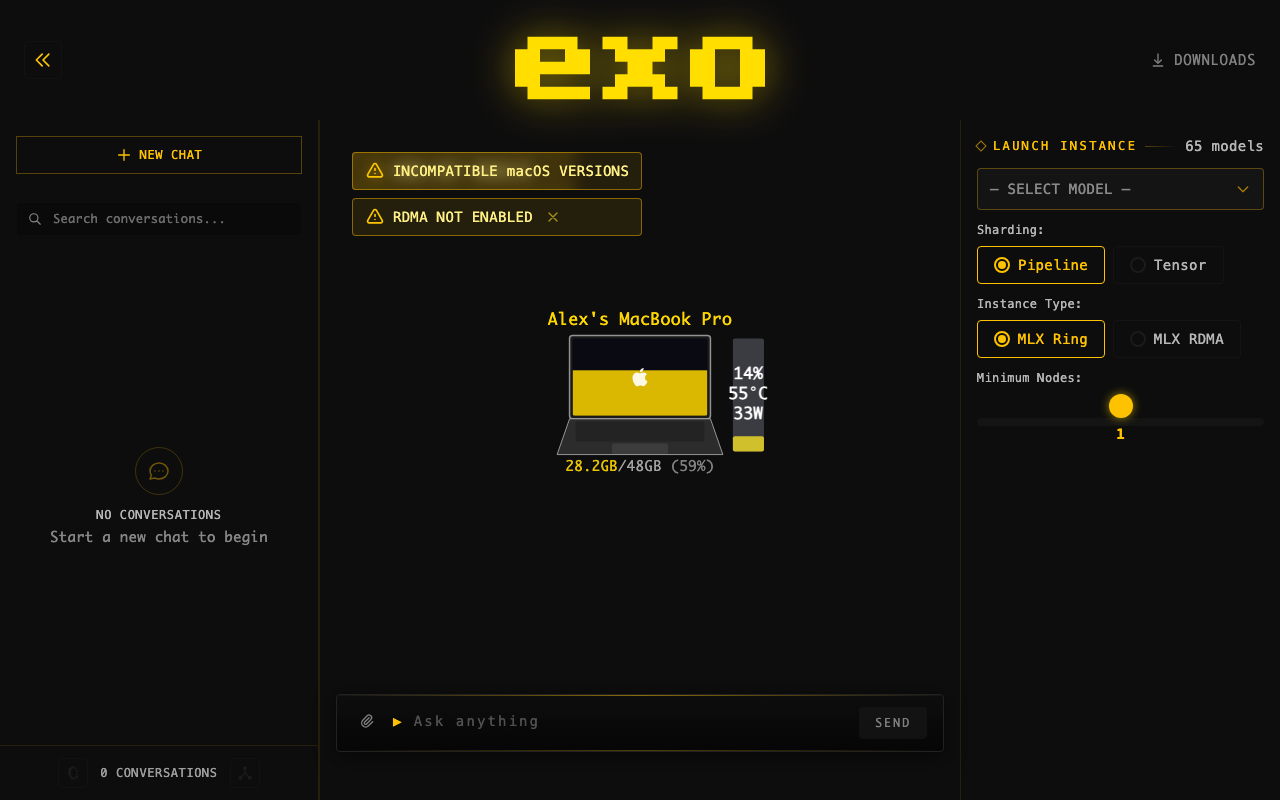
- Changed blue info badge "RDMA AVAILABLE" to yellow warning badge "RDMA
NOT ENABLED" — more accurately describes the state
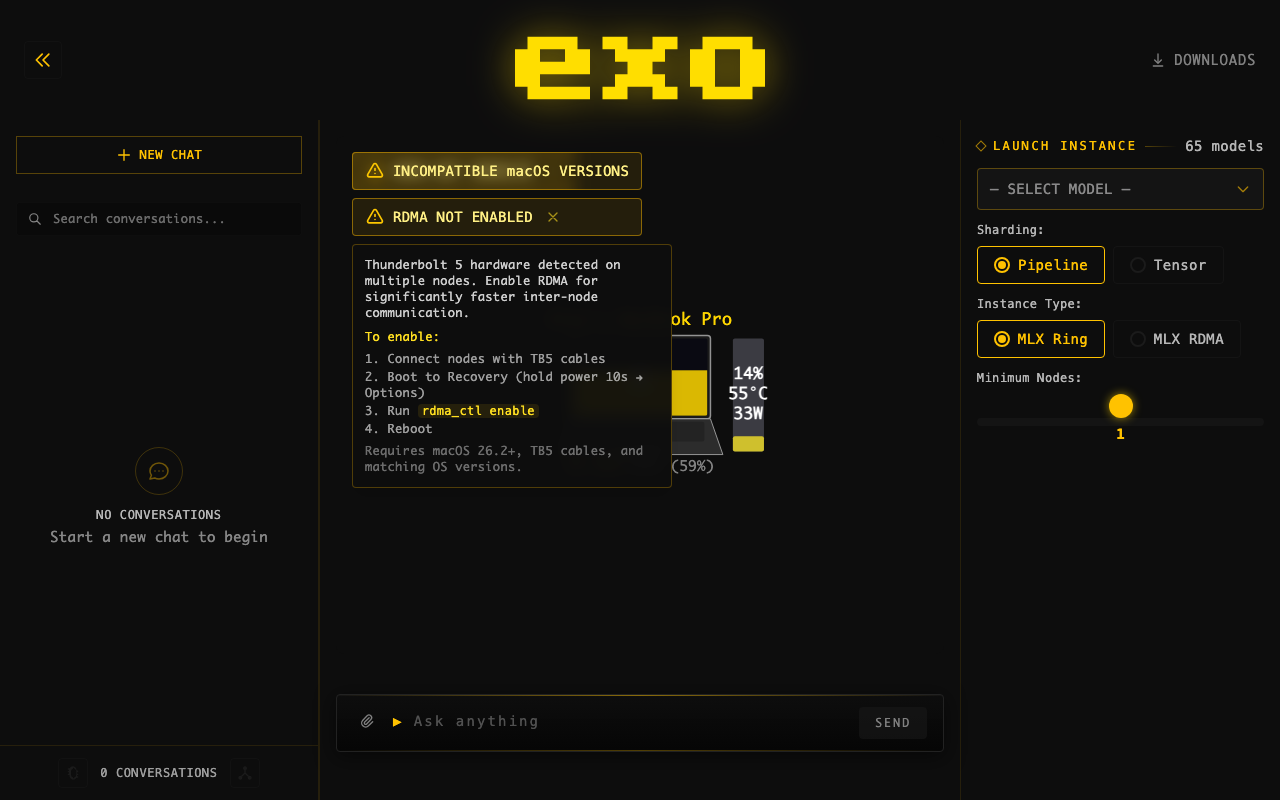
- Added hover tooltip with enable instructions to all views (was missing
in 2 of 4 instances)
- Warning icon instead of info icon, consistent with other cluster
warnings (TB cycle, macOS mismatch)
## Screenshots
**Badge (yellow warning):**
**Hover tooltip with instructions:**
## Test plan
- [x] Dashboard builds successfully
- [ ] Verify badge appears when 2+ TB5 nodes have RDMA disabled
- [ ] Verify hover tooltip shows in normal layout
- [ ] Verify hover tooltip shows in topology-only mode
- [ ] Verify dismiss button works
- [ ] Verify compact badge in status bar shows yellow warning
🤖 Generated with [Claude Code](https://claude.com/claude-code)
---------
Co-authored-by: Claude Opus 4.6 <noreply@anthropic.com>
Co-authored-by: rltakashige <rl.takashige@gmail.com>
Models in EXO_MODELS_PATH are pre-downloaded into read-only directories
and must not be deleted. The DownloadCoordinator had no awareness of
these paths, so they never appeared as completed downloads in cluster
state, and the bench harness could attempt to delete them when freeing
disk space.

Added a `read_only: bool` field to `DownloadCompleted` (default False).
The DownloadCoordinator now checks `resolve_model_in_path` in
`_start_download`, proactively scans EXO_MODELS_PATH in
`_emit_existing_download_progress` to emit DownloadCompleted events for
all pre-downloaded models (overriding DownloadPending from the regular
scan), and refuses deletion of read-only models. The bench harness
filters out read-only models from deletion candidates.

Test plan:
- Ran with EXO_MODELS_PATH. Available models now show as downloaded in
  the UI. There isn't good UI for the fact they can't be deleted, but it
  should work with exo_bench.
The Qwen3-Coder-Next model card TOML files were missing family,
quantization, base_model, and capabilities fields. This caused them not
to appear under the Qwen family filter in the dashboard's model picker.

Added the missing metadata to all five variants (4bit, 5bit, 6bit, 8bit,
bf16), matching the format used by the existing Qwen3-Coder-480B model
cards.

Test plan:
- Eyeballs
Users with pre-existing model files (e.g. on shared NFS mounts or from
prior downloads) had no way to point exo at those directories without
going through the download coordinator. EXO_MODELS_DIR only moves the
download target directory, it doesn't support read-only search paths.

Added EXO_MODELS_PATH environment variable as a colon-separated list of
directories to search for models. When the worker's plan loop encounters
a DownloadModel task, it checks these directories first and emits a
synthetic DownloadCompleted event if found, bypassing the download
coordinator entirely. The runner's build_model_path also checks these
directories first so the correct path is used during model loading.

This keeps the existing event sourcing state machine unchanged — the
DownloadCompleted event propagates naturally through the system, so
_load_model and all downstream logic work without modification.

Test plan:
- `s1@s1s-Mac-Studio ~ % EXO_LIBP2P_NAMESPACE=jake EXO_MODELS_PATH="/Volumes/Definitely Leo's SSD" nix --extra-experimental-features 'nix-command flakes' run github:exo-explore/exo/f2babbc2f742357d97dc177619fec062ef545be4`
- Started mlx-community/Qwen3-Coder-Next-4bit - it's present on the disk
  and it worked.
- Renamed one safetensor of mlx-community/Qwen3-Coder-Next-4bit on the
  disk. It then started the download locally, as expected.
## Problem

When a request is cancelled during prefill, the cancellation is not
detected until `check_for_cancel_every` additional tokens have been
generated. This is because `tokens_since_last_cancel_check` is
initialized to `0`, meaning the first cancel check only happens after
generating `check_for_cancel_every` tokens post-prefill.

For long prefills (which are the most likely to be cancelled), this adds
unnecessary latency before the cancellation is actually honoured.

## Fix

Initialize `tokens_since_last_cancel_check` to `check_for_cancel_every`
instead of `0`, so the very first token generated after prefill triggers
an immediate cancel check.

```diff
- tokens_since_last_cancel_check = 0
+ tokens_since_last_cancel_check = check_for_cancel_every
```

## Impact

- Cancellations issued during prefill are detected immediately when
generation begins
- No change in behaviour for non-cancelled requests (the counter resets
to `0` after each check as before)
- 1 line changed

Co-authored-by: rltakashige <rl.takashige@gmail.com>
## Summary
- Add downloaded_bytes field to existing DownloadPending event for
accurate resume progress
- Minimal change per maintainer directive — no new download states
introduced

## Test plan
- [x] 42 tests passed, 1 skipped
- [x] Verified downloaded_bytes populates correctly for partial
downloads

🤖 Generated with [Claude Code](https://claude.com/claude-code)

---------

Co-authored-by: Claude Opus 4.6 <noreply@anthropic.com>
Co-authored-by: rltakashige <rl.takashige@gmail.com>
we were seeing some crashes as lost download tasks were trying to push
data toward a deleted coordinator. this cancels download tasks with the
coordinator's shutdown on master election
## Motivation

We're going to be refactoring the llm inference code, so we should split
the runner up into parts while we can.

## Test Plan

### Manual Testing
Works on single node, at least.

### Automated Testing
Passes CI. Will be tested by our tests today.
addresses some election edge cases where a new worker with an old master
would get stuck on the old workers buffer index - we now use new system
ids each time we instantiate a node, and each event-producing system has
a unique system id for its lifespan (until the master moves).
The bench script downloads models during the planning phase but doesn't
record how long the download took, making it difficult to track download
performance for a given model over time.

Modified `run_planning_phase` to return download metadata: whether a
fresh download occurred, the wall-clock duration, and the model size in
bytes. These fields are included in every JSON output row alongside the
existing per-run metrics, and a summary line is logged to the console.

This allows filtering bench results by `download_occurred` and grouping
by `model_id` to compute average download times across runs.

Test plan:

```
# existing model
jake@maverick:/data/users/jake/repos/exo/ > nix run .#exo-bench -- --host s1 --model mlx-community/gpt-oss-120b-MXFP4-Q8 --pp 128 --tg 128
...
2026-02-20 15:23:49.081 | INFO     | __main__:main:340 - Planning phase: checking downloads...
2026-02-20 15:23:49.152 | INFO     | harness:run_planning_phase:402 - Started download on 12D3KooWKx41iikn188ozrxSdoG26g88jFCfie9wEA1eQR8csbPm
2026-02-20 15:23:49.184 | INFO     | __main__:main:352 - Download: model already cached
...
Wrote results JSON: bench/results.json
jake@maverick:/data/users/jake/repos/exo/ > cat bench/results.json
[
  {
    "elapsed_s": 2.9446684420108795,
    "output_text_preview": "The user just typed a long series of \"a\". Possibly they are testing. There's no explicit question. Could be they want a response? Might be a test of handling long input. We can respond politely, ask i",
    "stats": {
      "prompt_tps": 117.7872141515621,
      "generation_tps": 85.49598231498028,
      "prompt_tokens": 129,
      "generation_tokens": 128,
      "peak_memory_usage": {
        "inBytes": 68215145744
      }
    },
    "model_short_id": "gpt-oss-120b-MXFP4-Q8",
    "model_id": "mlx-community/gpt-oss-120b-MXFP4-Q8",
    "placement_sharding": "Pipeline",
    "placement_instance_meta": "MlxRing",
    "placement_nodes": 1,
    "instance_id": "68babc2a-6e94-4c70-aa07-7ec681f7c856",
    "pp_tokens": 128,
    "tg": 128,
    "repeat_index": 0
  }
]%
# no change to output
```

```
# missing model
jake@maverick:/data/users/jake/repos/exo/ > nix run .#exo-bench -- --host s1 --model mlx-community/Meta-Llama-3.1-8B-Instruct-4bit --pp 128 --tg 128
...
2026-02-20 15:24:42.553 | INFO     | __main__:main:340 - Planning phase: checking downloads...
2026-02-20 15:24:42.625 | INFO     | harness:run_planning_phase:402 - Started download on 12D3KooWKx41iikn188ozrxSdoG26g88jFCfie9wEA1eQR8csbPm
2026-02-20 15:25:37.494 | INFO     | __main__:main:350 - Download: 54.9s (freshly downloaded)
...
Wrote results JSON: bench/results.json
jake@maverick:/data/users/jake/repos/exo/ > cat bench/results.json
[
  {
    "elapsed_s": 1.500349276990164,
    "output_text_preview": "It seems like you've entered a large number of 'a's. If you'd like to discuss something or ask a question, I'm here to help. If not, is there anything else I can assist you with? \n\nIf you're intereste",
    "stats": {
      "prompt_tps": 395.43264952543666,
      "generation_tps": 128.03520443181478,
      "prompt_tokens": 129,
      "generation_tokens": 128,
      "peak_memory_usage": {
        "inBytes": 5116952079
      }
    },
    "model_short_id": "Meta-Llama-3.1-8B-Instruct-4bit",
    "model_id": "mlx-community/Meta-Llama-3.1-8B-Instruct-4bit",
    "placement_sharding": "Pipeline",
    "placement_instance_meta": "MlxRing",
    "placement_nodes": 1,
    "instance_id": "ccd9bd71-d4cc-4b75-a37f-98090544626a",
    "pp_tokens": 128,
    "tg": 128,
    "repeat_index": 0,
    "download_duration_s": 54.88322358299047
  }
]%
# one new field
```
## Summary
- On macOS, memory monitoring relied exclusively on `macmon` — the
psutil fallback was explicitly disabled (`memory_poll_rate = None`)
- When `macmon` is not installed (e.g., mac-mini-2 through mac-mini-4 in
our cluster), **no memory data was reported**, causing nodes to show 0GB
memory in the cluster state
- This blocked the scheduler from placing shards on those nodes since it
had no memory data to work with
- Fix: when `macmon` is not found on Darwin, fall back to psutil-based
memory polling (`memory_poll_rate = 1`)

## Root cause
`InfoGatherer` has two memory monitoring paths:
1. `macmon` (Darwin-only): provides memory + GPU/CPU/power stats
2. `psutil` (non-Darwin fallback): provides memory via
`MemoryUsage.from_psutil()`

Line 378 disabled psutil on Darwin: `memory_poll_rate = None if
IS_DARWIN else 1`
Line 389 only starts macmon if the binary exists: `if
shutil.which("macmon") is not None`

If macmon is missing on Darwin, **neither path runs** — zero memory
reported.

## Test plan
- [ ] Verify `uv run basedpyright` passes (0 errors confirmed)
- [ ] Verify `uv run ruff check` passes (confirmed)
- [ ] Verify `uv run pytest src/exo/utils/info_gatherer/` passes (2/2
confirmed)
- [ ] Deploy to cluster nodes without macmon and verify memory appears
in `/state`

🤖 Generated with [Claude Code](https://claude.com/claude-code)

---------

Co-authored-by: Claude Opus 4.6 <noreply@anthropic.com>
Co-authored-by: rltakashige <rl.takashige@gmail.com>
## Summary
- Show estimated time remaining during prefill (prompt processing phase)
- Track prefill start time via performance.now() and extrapolate from
observed token throughput
- Display ~Xs remaining or ~Xm Ys remaining next to the percentage on
the progress bar
- Wait 200ms before showing ETA to ensure a stable sample window

## Changes
**PrefillProgressBar.svelte**: Add etaText derived computation that
calculates remaining time from (remainingTokens / tokensPerMs). Renders
in a new flex row below the progress bar alongside the percentage.

**app.svelte.ts**: Add startedAt: number field to PrefillProgress
interface. Set on first prefill_progress SSE event, preserved across
subsequent updates.

## Test plan
- [ ] Start inference with a long prompt (10k+ tokens) on a multi-node
cluster
- [ ] Verify the progress bar shows ~Xs remaining after ~200ms of
prefill
- [ ] Verify the ETA decreases as prefill progresses
- [ ] Verify short prefills (<200ms) dont flash a briefly-visible ETA
- [ ] Verify ETA disappears when prefill completes and token generation
begins

Co-authored-by: Claude Opus 4.6 <noreply@anthropic.com>
Co-authored-by: rltakashige <rl.takashige@gmail.com>
## Summary
- Fixed stale docstring in `seed_models()` that referenced
`.cache/huggingface/hub` when the function actually moves models to
`EXO_MODELS_DIR` (resolved via `ensure_models_dir()`)
- The old docstring was misleading for AI coding agents analyzing the
codebase, causing incorrect conclusions about model storage paths

## Changes
`src/exo/download/download_utils.py`: Updated docstring from `"Move
model in resources folder of app to .cache/huggingface/hub"` to `"Move
models from resources folder to EXO_MODELS_DIR."`

Co-authored-by: rltakashige <rl.takashige@gmail.com>
## Motivation

Coordinator can be a random rank. Let's just fix this to rank 0 as
that's what we typically assume.

## Test Plan

### Manual Testing
Works as normal on 2 nodes.


Let's wait for a little more testing to merge this.

---------

Co-authored-by: Evan <evanev7@gmail.com>
## Motivation

TB has better bandwidth and latency than ethernet. We should prioritise
TB5 where possible. This drastically improves distributed image
generation performance.

## Test Plan

### Manual Testing
Saw on the dashboard that TB (169.254) addresses were prioritised.

Tested that image models scale much better.

### Automated Testing
No regression on Kimi K2.5
## Motivation
Occasionally, memory does not get released when we shut down. There is
no reason to delay deleting the model.

Also handles can become None during shutdown, causing TypeErrors which
are not handled and bringing down exo.

Similarly, we were closing the event sender in the wrong place.

Also let's not verify the SSL certificate for http connections to local
peers, as this is failing sometimes and crashing.

## Test Plan

### Manual Testing
No more crashes as described.
## Motivation

OpenCode shows <think> tags and not thinking blocks as we aren't
following the API specs properly.

Claude was also getting horrible prefix cache hits because it sends
headers.

## Changes

Handle thinking tokens properly by placing them in think tags for each
of the API endpoints.
Also support DeepSeekV3.2 tool calling properly as a minor feature.
Strips Claude headers at the API level.

## Test Plan

### Manual Testing
Tested OpenCode manually
Needs testing with Claude.

### Automated Testing
All CI and tests passing - added a new e2e test for DeepSeekV32 tool
parsing.
Rebuilt from scratch (replaces PR #1543). Detects when Mac Studio uses
RDMA over en2 (TB5 port next to Ethernet) which does not support RDMA.
Shows dismissible warning banner with hover tooltip showing affected
devices, SVG rear panel illustration, and fix instructions. 205 lines in
+page.svelte.

---------

Co-authored-by: Claude Opus 4.6 <noreply@anthropic.com>
Co-authored-by: rltakashige <rl.takashige@gmail.com>
## Motivation
Our hits are really bad at the moment (0.2%). This PR makes it 98.5% on
average.

## Changes

Also adds an example for how to run Claude using Exo.

## Why It Works
Claude sends some billing and session headers that change with each
message.

## Test Plan

### Manual Testing
Works in manual testing.
this should never have been a separate event, but i didnt quite
communicate that well when this was merged. convert PrefillProgress to a
chunk like the rest of the runner responses.

tested with Llama-3.3-70B, prefill progress events still show up in the
dashboard as usual
c2f2111b extracted shared utilities from exo_bench.py into harness.py
but accidentally dropped the run_planning_phase function and
--danger-delete-downloads CLI argument in the process.

Restored run_planning_phase in harness.py (where its dependencies now
live) and re-added the --danger-delete-downloads argument to
add_common_instance_args. Re-wired the planning phase call in
exo_bench.py's main() before the benchmark loop.
## Summary
- `ResponsesStreamEvent` was defined in `openai_responses.py` as a union
of all 11 streaming event types but never imported or used anywhere in
the codebase
- Import it in the responses adapter and add a `_format_sse(event:
ResponsesStreamEvent) -> str` helper
- Replace 13 hardcoded `f"event: {type}\ndata:
{event.model_dump_json()}\n\n"` strings with `_format_sse()` calls

## Test plan
- [x] `uv run basedpyright` — 0 errors
- [x] `uv run ruff check` — all checks passed
- [x] `nix fmt` — 0 files changed
- [x] `uv run pytest` — 188 passed, 1 skipped

🤖 Generated with [Claude Code](https://claude.com/claude-code)

Co-authored-by: Claude Opus 4.6 <noreply@anthropic.com>
# Cancel task finalization (main.py)

After forwarding the cancel to the runner supervisor, emit TaskStatusUpdated(Complete) for the cancel task itself. This ensures the cancel task is properly removed from state.tasks.
## Motivation
There's no way to easily use the cancellation features we added! Also,
prefill can take ages so let's allow cancelling out of that.

## Changes

Wiring up our existing functionality to easily cancel during generation
(and adding stuff to do so during prefill)

## Test Plan

### Manual Testing
Tested it works during both prefill and decode.

### Automated testing
Needs testing to see if this causes a GPU timeout error on large prefill
on large models in pipeline parallel. However, from manually testing GLM
5 pipeline ring on 2 nodes, and from reading the code, it does not seem
like this will be the case.
## Motivation

Users processing long prompts have no visibility into when token
generation will start. This feature adds a progress bar showing prefill
progress, giving users real-time feedback during prompt processing.

## Changes

### Backend
- Added `PrefillProgress` event type with `command_id`,
`processed_tokens`, `total_tokens`
- Added `PrefillProgressResponse` type (though now using direct callback
approach)
- Wired `prompt_progress_callback` through MLX's `stream_generate()`
- Progress events sent directly from callback for real-time updates (not
batched)
- API generates SSE named events: `event: prefill_progress\ndata: {...}`
- Added `PrefillProgressData` dataclass and `StreamEvent` union type in
API

### Dashboard
- Added `PrefillProgress` interface to store
- Updated SSE parsing to handle `event:` lines (named events)
- Created `PrefillProgressBar.svelte` with animated progress bar
- Shows "Processing prompt: X/Y tokens" with percentage
- Progress bar disappears when first token arrives

## Why It Works

MLX's `stream_generate()` accepts a `prompt_progress_callback(processed,
total)` that's called after each prefill chunk. By sending events
directly from this callback (rather than yielding from the generator),
progress updates are sent in real-time during prefill.

Using SSE named events (`event: prefill_progress`) maintains full
OpenAI/Claude API compatibility - standard clients ignore named events
they don't recognize, while the exo dashboard explicitly listens for
them.

## Test Plan

### Manual Testing
- Hardware: MacBook Pro M3 Max
- Set `prefill_step_size=256` for more frequent updates
- Tested with long prompts (pasted large documents)
- Verified progress bar updates incrementally during prefill
- Confirmed progress bar disappears when generation starts
- Tested with curl - standard `data:` events still work normally

Here is it working:


https://github.com/user-attachments/assets/5cc6f075-c5b2-4a44-bb4d-9efb246bc5fe


### Automated Testing
- Type checker passes (0 errors)
- All 192 tests pass
- Dashboard builds successfully

### API Compatibility
- Named SSE events are ignored by OpenAI SDK clients
- Regular token data uses standard `data: {...}` format
- `[DONE]` sentinel works as expected

---

**Note:** `prefill_step_size` is temporarily set to 256 for testing.
Should be changed back to 2048 before merging for production
performance.

---------

Co-authored-by: Claude Opus 4.5 <noreply@anthropic.com>
Co-authored-by: Evan <evanev7@gmail.com>
Co-authored-by: Ryuichi Leo Takashige <leo@exolabs.net>
## Summary
- `_test_internet_connection()` previously only tried `1.1.1.1:443`,
which some ISPs/networks block, causing exo to incorrectly report no
internet and fail downloads on startup
- Now tries `1.1.1.1`, `8.8.8.8`, and `1.0.0.1` in sequence, succeeding
if any endpoint responds
- Returns early on first success for minimal latency in the common case
Fixes#1425
## Test plan
- [ ] Verify downloads work on networks that block `1.1.1.1`
- [ ] Verify existing behavior unchanged on networks where `1.1.1.1`
works
- [ ] Verify `internet_connection` is set to `False` only when all three
endpoints fail
🤖 Generated with [Claude Code](https://claude.com/claude-code)
Co-authored-by: Claude Opus 4.6 <noreply@anthropic.com>
Co-authored-by: rltakashige <rl.takashige@gmail.com>
## Summary

- `MpReceiver.close()` did not unblock threads stuck on `queue.get()` in
`receive_async()`, causing abandoned threads (via
`abandon_on_cancel=True`) to keep the Python process alive indefinitely
after tests pass
- This caused the `aarch64-darwin` CI jobs in PR #1462 to hang for ~6
hours until the GitHub Actions timeout killed them
- Sends an `_MpEndOfStream` sentinel before closing the buffer,
mirroring what `MpSender.close()` already does

## Test plan

- [x] `uv run basedpyright` — 0 errors
- [x] `uv run ruff check` — clean
- [x] `nix fmt` — 0 changed
- [x] `uv run pytest` — 188 passed, 1 skipped in 12s (no hang)

🤖 Generated with [Claude Code](https://claude.com/claude-code)

---------

Co-authored-by: Claude Opus 4.6 <noreply@anthropic.com>
Co-authored-by: rltakashige <rl.takashige@gmail.com>
Co-authored-by: Ryuichi Leo Takashige <leo@exolabs.net>
## Summary
- Adds model cards for MiniMax M2.5 in three quantizations: 4bit (~129
GB), 6bit (~186 GB), 8bit (~243 GB)
- No code changes needed — `MiniMaxM2ForCausalLM` is already in the
tensor parallel whitelist and `MiniMaxShardingStrategy` is already
implemented in `auto_parallel.py`
- Credit to @vskiwi for confirming MiniMax M2.5 works out of the box
with existing code
Closes#1480
## Test plan
- [x] `basedpyright` passes with 0 errors
- [x] `ruff check` passes
- [x] `pytest` passes (260 passed, 1 skipped)
- [ ] Verify MiniMax M2.5 models appear in model selector on dashboard
🤖 Generated with [Claude Code](https://claude.com/claude-code)
Co-authored-by: Claude Opus 4.6 <noreply@anthropic.com>
Co-authored-by: rltakashige <rl.takashige@gmail.com>
## Motivation

GPT OSS tool calling issues.

## Changes

Fixes those and adds a bunch of evals for tool calling.
Fixes GLM5 prefix caching, where CacheList wasn't getting handled
properly.
Extracts a bunch of the setup functionality of exo bench to a harness
that can be reused elsewhere, such as in the tool calling eval.

## Test Plan
### Automated Testing
Let's run the evals for all models
 Alex Cheema

